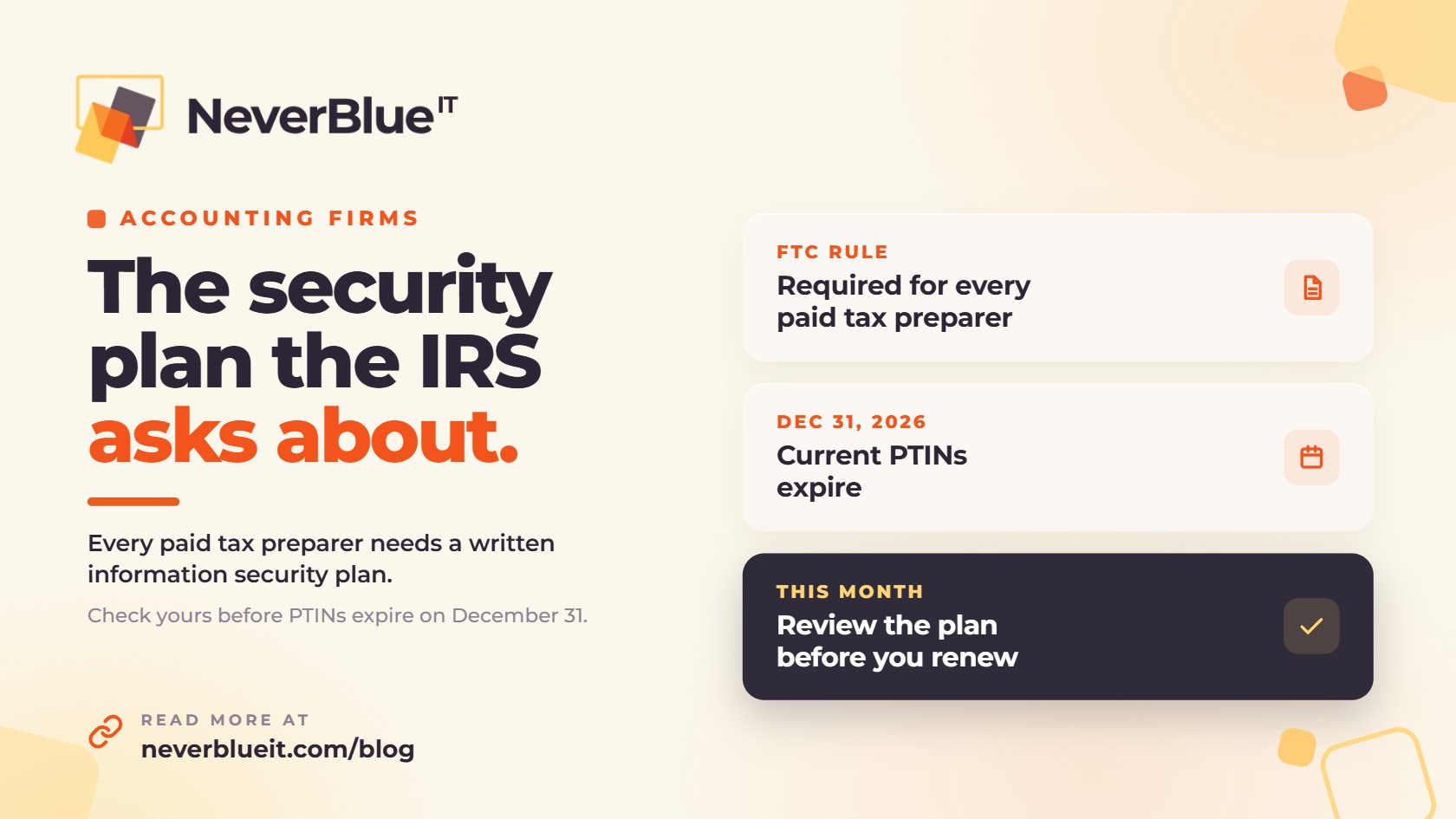
A written information security plan, or WISP, is the document that spells out how your firm protects client data, and federal law requires every paid tax preparer to have one. The requirement comes from the FTC Safeguards Rule, which treats accountants and tax preparers as financial institutions. The IRS raises it every year, when the PTIN renewal form asks you to acknowledge it.
This post is for partners and office managers at CPA and tax preparation firms. Current PTINs expire on December 31, 2026, so the next few weeks are a good time to check the plan against how the office works today.
Who needs a written information security plan
The FTC Safeguards Rule applies to financial institutions, and its definition names accountants and tax preparation services that are in the business of completing income tax returns. There is no minimum size, so a solo preparer is covered too.
In an IRS and Security Summit reminder from August 2026, the IRS stated that federal law requires tax and accounting professionals to create and maintain a WISP. The IRS says a plan works best when it is tailored to the size and complexity of the firm and the sensitivity of its data.
What the FTC Safeguards Rule requires
The rule (16 CFR Part 314) says the security program has to be in writing and lists what it must cover. Firms that maintain customer information on fewer than 5,000 consumers are excused from four items. The rest apply to everyone.
| Requirement | Firms with fewer than 5,000 consumers |
|---|---|
| A Qualified Individual in charge of the program | Required |
| Written risk assessment | Exempt |
| Access controls, encryption and multi-factor authentication | Required |
| Secure disposal of client data within two years of last use, unless there is a business or legal reason to keep it | Required |
| Continuous monitoring, or yearly penetration tests and vulnerability scans every six months | Exempt |
| Security awareness training for staff | Required |
| Oversight of service providers | Required |
| Written incident response plan | Exempt |
| Annual written report to the board | Exempt |
| Notice to the FTC within 30 days of a breach involving 500 or more consumers | Required |
We would still write the exempt items down. The IRS advises tax professionals to create a data theft response plan.
What goes in a WISP for an accounting firm
The IRS groups the plan into three areas: employee management and training, information systems, and detecting and managing system failures. The plan should say:
- Who coordinates the security program
- Where client data lives, including tax software, the document portal, email, laptops, paper files and backups
- Who can get into each of those, and how access is removed when someone leaves
- Which protections are in place, such as antivirus, firewalls, backups, drive encryption, multi-factor authentication and a VPN
- Which vendors hold client data, how staff are trained, and what happens if data is stolen
IRS Publication 5708 is a WISP template written with smaller practices in mind. Our post on phishing training covers the emails staff should practice spotting.
How to check your written information security plan before PTIN renewal
The IRS PTIN renewal reminder for 2027 says renewing online takes about 15 minutes and costs $18.75. Before you reach the data security question, run these checks.
- Find the current plan and look at its date. If it names people who have left, start there.
- Confirm who is in charge of the security program and that they know it.
- Add anything new since last year, such as a new portal or an AI tool that reads client documents.
- Check that multi-factor authentication is on for every system that holds client data, including email and remote access.
- Check that laptops are encrypted and that someone has tested restoring a file from backup.
The IRS suggests keeping the plan as a PDF or Word document, with a digital copy stored in case of a natural disaster or emergency. It also says to review, test and update the plan regularly.
What happens if your firm does not have one
In a November 2023 alert, the IRS Office of Professional Responsibility said that failing to keep a WISP may expose a practitioner to liability for violating both the Safeguards Rule and the terms of their malpractice insurance. Willful cases could also lead to discipline under Circular 230.
If unencrypted information on 500 or more consumers is acquired without authorization, the firm must notify the FTC within 30 days of discovering it. That requirement took effect on May 13, 2024, and the exemption for smaller firms does not remove it.
How NeverBlue IT helps with a written information security plan
NeverBlue IT is a 100% family-owned managed IT provider with over 30 years of experience and offices in Windermere, FL and Farmington Hills, MI. We support accounting firms across Central Florida and Southeast Michigan.
A large part of a WISP is IT work. Our onboarding includes a full inventory of computers, systems and passwords, which is the same inventory the plan calls for. Cyber security and disaster recovery are two of our core services, so the protections and backups the plan describes are things we set up and look after. The legal judgment calls stay with you and your counsel.
Your dedicated team lead visits onsite every month, so there is a regular time to bring up a new hire or new software. The service is a fixed monthly price on a month-to-month agreement.
Book a free IT assessment to talk through your firm’s setup before tax season.
Frequently asked questions
Is a written information security plan required by law?
Yes. The FTC Safeguards Rule covers accountants and tax preparation services, and the IRS states that federal law requires tax and accounting professionals to create and maintain one.
Does a sole practitioner need a WISP?
Yes. The rule has no minimum firm size. Firms with information on fewer than 5,000 consumers are exempt from four items, including the written risk assessment and the written incident response plan.
Is multi-factor authentication required for accounting firms?
Yes. The Safeguards Rule requires multi-factor authentication for anyone accessing an information system, unless the firm’s Qualified Individual approves an equivalent or stronger control in writing.
How often should a WISP be updated?
The IRS says to review, test and update it regularly and to adjust it when operations change. We suggest reading it at least once a year, at PTIN renewal.
When do PTINs expire, and what does renewal cost?
Current PTINs expire on December 31, 2026. The IRS says the fee for 2027 is $18.75 and that renewing online takes about 15 minutes.